Quick read
- Combined single-family closings rose to 1,045 in September from 945 in August, up 10.6%, the first monthly increase since June.
- New listings jumped to 420 in San Mateo County from 358, and to 943 in Santa Clara County from 872. Active inventory rose to 476 and 1,224.
- San Mateo County's median rose to $2,175,000, and sellers averaged 106% of list, down from 107% in August.
- Santa Clara County's median rose to $1,880,000, and sellers averaged 103% of list, unchanged.
- South San Francisco, Millbrae, Daly City, Palo Alto, Mountain View and Burlingame led on competitive pressure, each clearing 109% of list or better.
- Santa Clara County's condo and townhome segment held flat: an $852,500 median, 100% of list, and 262 sales against 901 active listings.
What Happened to the Silicon Valley Housing Market in September 2026?
More homes came to market, more homes sold, and the ones that closed drew slightly softer bids than they had in August.
Single-family closings rose to 1,045 in September from 945 in August, up 10.6%, after two straight monthly declines from June's 1,255. Santa Clara County did the lifting: 726 closings against 624 in August, up 16.3%.
San Mateo County held level at 319 against 321. Combined sale volume rose to $2,655,248,771 from $2,430,089,941.
Medians rose in both counties. San Mateo County's median settled at $2,175,000, up 4.8% from August's $2,075,000. Santa Clara County's settled at $1,880,000, up 1.6% from $1,850,000.
Median price per square foot told a flatter story: $1,167 in San Mateo County against $1,174, and $1,095 in Santa Clara County against $1,068. Part of the median move is which homes closed.
Sellers in San Mateo County averaged 106% of list, down from 107% in August. Sellers in Santa Clara County averaged 103%, unchanged. Average days on market lengthened to 28 from 25 in San Mateo County and to 27 from 25 in Santa Clara County.
The supply side is the month's real change. New listings rose 17.3% in San Mateo County, to 420, and 8.1% in Santa Clara County, to 943.
Active inventory rose to 476 and 1,224 homes, and San Mateo County's months of supply moved to 1.4 from 1.1. Still a seller's figure, but the widest since the spring listing season.
| Measure | June | July | August | September |
|---|---|---|---|---|
| San Mateo median price | $2,150,000 | $2,123,000 | $2,075,000 | $2,175,000 |
| San Mateo homes sold | 434 | 366 | 321 | 319 |
| San Mateo avg. days on market | 20 | 25 | 25 | 28 |
| San Mateo % of list received | 107% | 106% | 107% | 106% |
| San Mateo months of supply | 1.1 | 1.0 | 1.1 | 1.4 |
| Santa Clara median price | $1,910,000 | $1,900,000 | $1,850,000 | $1,880,000 |
| Santa Clara homes sold | 821 | 711 | 624 | 726 |
| Santa Clara avg. days on market | 22 | 27 | 25 | 27 |
| Santa Clara % of list received | 103% | 102% | 103% | 103% |
Source: SAMCAR and SCCAOR, data collected and compiled by MLSListings, Inc. Santa Clara County does not publish months of supply.
Did Mortgage Rates Shape September's Numbers?
Not yet. September closings reflect contracts written in August and the first days of September, when Freddie Mac's Primary Mortgage Market Survey had the 30-year fixed rate between 6.65% on August 20 and 6.71% on September 3.
The rate moved after those contracts were signed. Freddie Mac logged 6.71% on September 3, 6.76% on September 10, 6.95% on September 17, 7.03% on September 24, 7.28% on October 1, and 7.40% on October 8.
The buyers who set September's medians borrowed at the lower figures. The buyers writing offers now are borrowing at the higher ones, and that shows up in October's closings rather than in these. The 7% note covers what that threshold has meant for Peninsula sellers and buyers.
Where Did Buyers Compete Hardest in September 2026?
Percent of list price is the cleanest measure of competitive pressure. Save this list, it's the fastest way to see where an offer needed to be sharp this month.
- South San Francisco: 113% of list, an average of 17 days, 14 sales, a $1,505,750 median, 1.4 months of supply.
- Millbrae: 113% of list, an average of 8 days, the fastest pace in either county among cities with five or more sales, for a second month, 12 sales, a $2,355,000 median, 0.6 months of supply.
- Daly City: 111% of list, up from 106% in August, an average of 20 days, 32 sales, a $1,240,000 median.
- Palo Alto: 109% of list, down from 111%, an average of 16 days, 40 sales (August had 32), a $4,168,500 median, $2,157 per square foot.
- Mountain View: 109% of list, up from 107%, an average of 20 days, 29 sales (August had 12), a $3,020,000 median.
- Burlingame: 109% of list, up from 107%, an average of 18 days, 15 sales, a $3,195,000 median, 0.8 months of supply.
- San Carlos: 108% of list, an average of 18 days, 19 sales, a $2,750,000 median, 0.8 months of supply.
- Los Altos: 108% of list, an average of 22 days, 25 sales, a $5,126,000 median, $2,164 per square foot.
- Sunnyvale: 107% of list, an average of 10 days, 53 sales (August had 41), a $2,820,000 median.
- San Mateo: 107% of list, down from 113% in August, an average of 14 days, 44 sales (August had 29), a $2,175,000 median, 0.9 months of supply.
- Menlo Park: 104% of list, down from 106%, an average of 18 days, 26 sales, a $4,169,194 median (August was $3,610,000, which tracks a change in the mix of homes that sold), $1,827 per square foot, 36 new listings, 1.3 months of supply.
"September's buyers had more to look at, and they paid for it a little less eagerly. The bidding carried on, and it got selective."
Atherton closed 5 sales at a $13,000,000 median, 103% of list, and an average of 15 days, on 2.3 months of supply. Five sales is the floor for a readable median, so take the figure with the count beside it. Hillsborough is covered below, because September put it on the other list.
| City | Median price | Sold | Avg. DOM | % of list |
|---|---|---|---|---|
| Atherton | $13,000,000 | 5 | 15 | 103% |
| Los Altos Hills | $6,500,000 | 9 | 22 | 100% |
| Hillsborough | $6,075,000 | 12 | 42 | 98% |
| Los Altos | $5,126,000 | 25 | 22 | 108% |
| Woodside | $4,602,500 | 6 | 15 | 104% |
| Menlo Park | $4,169,194 | 26 | 18 | 104% |
| Palo Alto | $4,168,500 | 40 | 16 | 109% |
| Saratoga | $4,100,000 | 24 | 34 | 100% |
| Cupertino | $3,210,000 | 18 | 14 | 106% |
| Burlingame | $3,195,000 | 15 | 18 | 109% |
| Mountain View | $3,020,000 | 29 | 20 | 109% |
| Sunnyvale | $2,820,000 | 53 | 10 | 107% |
| San Carlos | $2,750,000 | 19 | 18 | 108% |
| Belmont | $2,715,000 | 21 | 26 | 105% |
| Los Gatos | $2,550,000 | 25 | 38 | 103% |
| Redwood City | $2,455,000 | 41 | 21 | 104% |
| Millbrae | $2,355,000 | 12 | 8 | 113% |
| San Mateo | $2,175,000 | 44 | 14 | 107% |
| Santa Clara | $1,817,000 | 40 | 20 | 105% |
| Morgan Hill | $1,560,000 | 21 | 35 | 99% |
| Gilroy | $1,129,000 | 32 | 45 | 100% |
Source: SAMCAR and SCCAOR, data compiled by MLSListings, Inc. A selection across both counties and every price tier. The full city list runs longer. Cities with fewer than five closed sales are left out, because one transaction can move their median by seven figures: Brisbane (1 sale), Colma (1), Foster City (4), La Honda (2), Montara (4), Moss Beach (2), Portola Valley (4), Redwood Shores (2), Monte Sereno (3), San Martin (2) and Stanford (0) in September.
Which Peninsula Markets Are Running Slower Right Now?
Hillsborough, Saratoga, Los Altos Hills and south Santa Clara County are the honest counterweight to the list above, and two coastside towns that led this section in August have moved off it.
Hillsborough averaged 98% of list across 12 sales, down from 106% in August, at an average of 42 days against 21 active listings, 2.0 months of supply. The median was $6,075,000 and the average sale price $7,489,156, so a few large closings still pulled the average up, but the bidding did not follow.
Saratoga averaged exactly 100% of list across 24 sales and 34 days, down from 103%. Los Altos Hills also averaged 100%, across 9 sales and 22 days, at a $6,500,000 median, an improvement on August's 97%.
South Santa Clara County stayed balanced. Morgan Hill carried 82 active listings against 21 sales at 99% of list and an average of 35 days. Gilroy carried 87 active listings against 32 sales at 100% and 45 days.
Campbell cleared 102% but took an average of 45 days across 18 sales. Los Gatos cleared 103% across 25 sales and 38 days against 86 active listings, faster than August's 51 days and on nearly twice the sales. East Palo Alto averaged 99% across 6 sales.
Half Moon Bay and Woodside, the two slow lanes of August, both tightened. Half Moon Bay averaged 103% of list across 7 sales and 36 days, from 95% and 65 days, though 2.9 months of supply keeps it a buyer's conversation.
Woodside averaged 104% across 6 sales and 15 days, from 99% and 33 days, against 28 active listings and 3.7 months of supply. Six sales is a thin read, so weigh the 28 active listings more heavily.
Redwood City sits between the lists: 104% of list, down from 107%, across 41 sales and an average of 21 days, at a $2,455,000 median. It added 59 new listings in September, the most of any San Mateo County city.
Is the Santa Clara County Condo Market Still Soft?
It held flat. Santa Clara County's condominium and townhome segment neither recovered nor softened further in September, and it remains the one tier where the average seller took exactly list.
The median was $852,500, from $850,000 in August. Closed sales eased to 262 from 275 while new listings rose to 459 from 419, and active inventory finished at 901, from 894.
Average days on market lengthened to 42 from 40, and sellers averaged 100% of list for a second month. Median price per square foot edged up to $688 from $682.
| Measure | August | September |
|---|---|---|
| Median price | $850,000 | $852,500 |
| Closed sales | 275 | 262 |
| New listings | 419 | 459 |
| Active inventory | 894 | 901 |
| Avg. days on market | 40 | 42 |
| % of list received | 100% | 100% |
| Median $/sqft | $682 | $688 |
Source: SCCAOR, data collected and compiled by MLSListings, Inc.
Mountain View was the exception inside the segment: 25 condo and townhome sales at a $1,475,000 median and 103% of list, an average of 30 days. San Jose, which carries half the county's condo volume, closed 127 at a $729,000 median and 99% of list across an average of 44 days.
Want to see how your city compares on price, pace, and percent of list received? The home price benchmark calculator is now loaded with September 2026 closed-sale data for 41 Peninsula and Silicon Valley cities.
What Does September Mean If You're Buying or Selling?
The practical read depends on which side of the transaction you're on.
If you're selling
- You have more company. San Mateo County added 420 listings against 319 sales, and Santa Clara County added 943 against 726. Supply in San Mateo County rose to 1.4 months. A prepared, correctly priced listing still won in September, and it won against more neighbors.
- The bid eased by a single point. A 106% average in San Mateo County and 103% in Santa Clara County still means the typical well-priced home closed above asking. Price to what closed on your street this month rather than to what closed in June.
- The estate tier slowed. Hillsborough averaged 42 days at 98% of list, and Atherton's five sales averaged 103%. Build six to eight weeks into expectations before you list at that tier.
- Rates moved after this data closed. Freddie Mac's 30-year reading crossed 7% on September 24 and reached 7.40% on October 8. Buyers writing offers in October carry a higher payment than the ones who set September's numbers.
If you're buying
- There's more to choose from. Active inventory rose 12% in San Mateo County and 11% in Santa Clara County in one month. In a few more places this month, you had the weekend to think it over.
- Negotiating room showed up in specific places. Hillsborough, Saratoga, Los Altos Hills, south Santa Clara County and the condo segment are where September shows the average seller taking list or less. Campbell cleared 102% but took an average of 45 days.
- Millbrae, Sunnyvale, San Mateo, Cupertino and Palo Alto moved fast. Each averaged 16 days or fewer on market. A slow decision there still costs you the house.
- Look past the median to percent of list. Menlo Park's median rose 15% in a month on 26 sales while its percent of list fell to 104%. The second number tells you more about the offer you'll need than the first.
For the longer view, the Silicon Valley Real Estate Market Report tracks the trend across the year, and the August 2026 report covers the quieter month that came before.
Frequently Asked Questions
Q: Did home prices rise in San Mateo and Santa Clara Counties in September 2026?
A: Modestly. San Mateo County's median rose 4.8% to $2,175,000. Santa Clara County's median rose 1.6% to $1,880,000. Both moved with a larger and broader set of closings, 1,045 across the two counties against 945 in August, so the higher median tracks which homes sold as much as what buyers paid.
Q: Why did home sales rebound in September 2026?
A: More homes came to market. San Mateo County logged 420 new listings against 358 in August, and Santa Clara County logged 943 against 872. Combined closings rose to 1,045 from 945, the first monthly increase since June. September closings reflect contracts written in August and the first days of September, when Freddie Mac's 30-year readings ran 6.65% to 6.71%.
Q: Which Silicon Valley and Peninsula cities were strongest in September 2026?
A: By percent of list price received, South San Francisco and Millbrae led at 113%, followed by Daly City at 111% and Palo Alto, Mountain View and Burlingame at 109%. Millbrae was also the fastest city with five or more sales in either county, clearing 12 in an average of 8 days, and Sunnyvale closed 53 sales in an average of 10 days.
Q: Is the Santa Clara County condo market still soft in 2026?
A: It held flat rather than softening further. The condominium and townhome median was $852,500, from $850,000 in August. Sellers averaged 100% of list for a second month, 262 units closed against 901 active listings, and average days on market lengthened to 42 from 40.
Q: Where is there room to negotiate in this market right now?
A: Hillsborough, where sellers averaged 98% of list across 42 average days on market and 2.0 months of supply. Morgan Hill at 99% and Gilroy at 100%, each carrying more than 80 active listings. Saratoga and Los Altos Hills both averaged exactly 100% of list, and Campbell took 45 days. Freddie Mac's 30-year rate crossed 7% on September 24, which will shape October's contracts.
The bottom line
September reopened the market. Closings rose to 1,045 across both counties, the first monthly gain since June, as new listings climbed 17% in San Mateo County and 8% in Santa Clara County. Medians rose with the broader mix, to $2,175,000 and $1,880,000, and sellers still averaged above list, 106% and 103%.
The openings have names: Hillsborough and the estate tier, Saratoga, Campbell, south Santa Clara County, and condominiums. Rates crossed 7% after this data closed, so October's report will be the first to show what that did to the bidding.
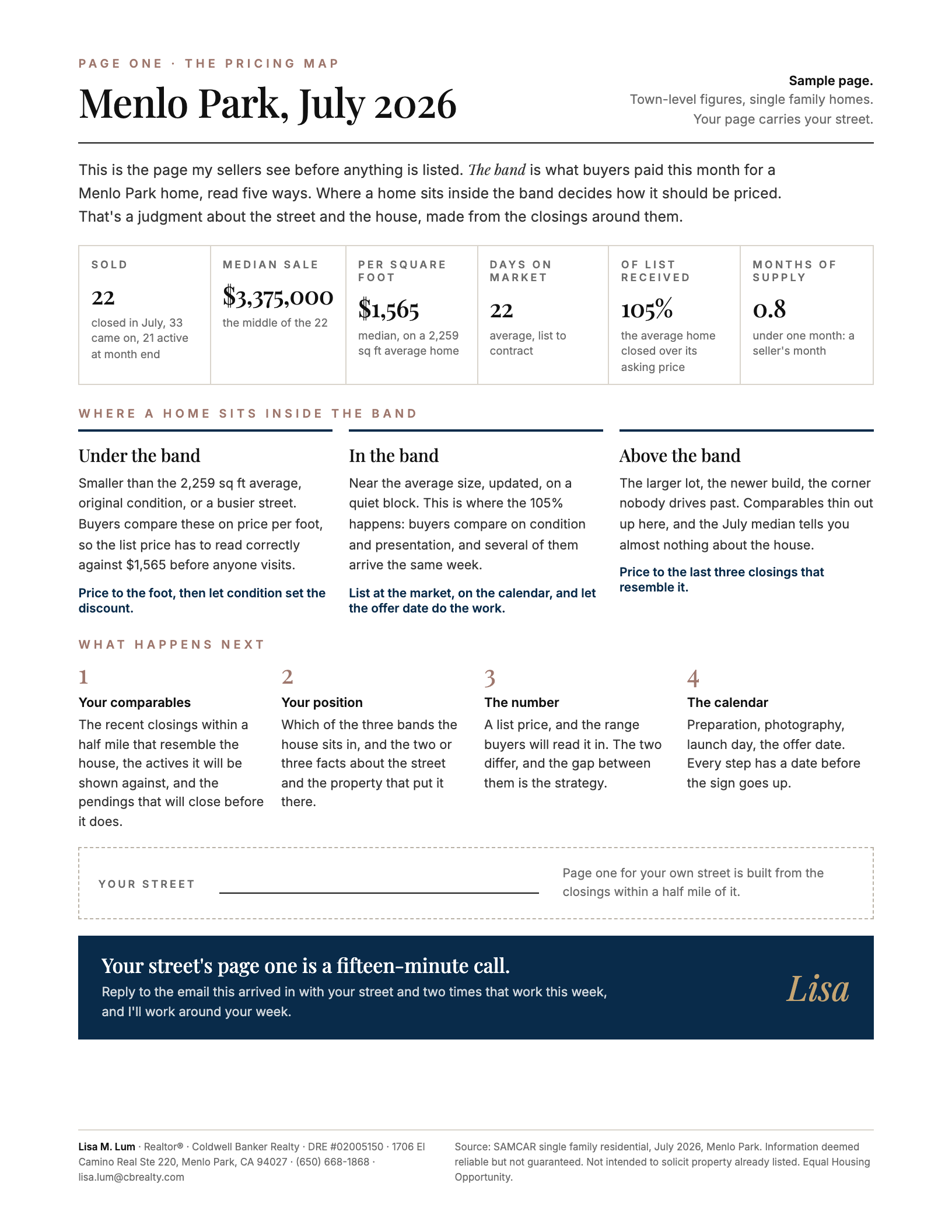
Every figure above is a countywide or citywide average. If you want the same read narrowed to your own street, ask for Page One, the one-page pricing map built from this same closed-sale data.
Stay informed: Get monthly market updates and neighborhood insights delivered to your inbox. Subscribe to Lisa's Market Minute.
Know anyone thinking about selling? Send them the home valuation tool.