Quick read
- The 30-year fixed hit 7.22% on September 15 per Mortgage News Daily, the sharpest six-day jump since October 2024, and the Fed raised its benchmark rate a quarter point on September 16
- National purchase applications were 19% below the same week last year; refinance applications were 65% lower
- The Peninsula runs on jumbo loans and cash, so the national number overstates what happens here, but a 7% jumbo rate does thin the financed buyer pool between $2 million and $4 million
- July 2026 county data still shows sellers in control: San Mateo County at 1.0 months of inventory and 106% of list, Palo Alto at 17 days on market and 108% of list
- Seven moves for sellers and buyers in a 7% market, ending with the one-page pricing map every seller should see before listing
What Happened to Mortgage Rates This Week?
The average 30-year fixed mortgage rate crossed 7% in the second week of September 2026, and the Federal Reserve raised its benchmark rate for the first time in more than three years on September 16. National purchase mortgage applications fell 19% from the same week a year ago.
The numbers come from the Mortgage Bankers Association's weekly survey, reported by CNBC on September 16. For the week ending September 11, total mortgage application volume fell 4.1% from the prior week.
The average contract rate for a 30-year fixed with a conforming balance rose to 6.97% from 6.85%. That's its highest level since May 2025. Jumbo balances moved faster: the jumbo 30-year rose 29 basis points to 7.03% in a single week.
Then the daily surveys caught up. Mortgage News Daily put the 30-year fixed at 7.22% on Tuesday, September 15.
Matthew Graham, the firm's chief operating officer, wrote that the average was up 0.33 percentage points over six business days, "the most abrupt jump since October 2024." Rates now sit almost a full percentage point above a year ago.
On Wednesday the Fed confirmed the direction. The Federal Open Market Committee voted 12 to 0 to raise the federal funds rate by 25 basis points to a range of 3.75% to 4.00%. Sixteen of the 18 participants projected at least one more increase this year, and the statement described inflation as still running high. CNBC's coverage of the decision tied the overshoot in part to oil prices.
The 10-year Treasury yield, which mortgage rates track more closely than the Fed's own rate, moved near 5% this week. That's its highest level since 2007.
Joel Kan, the MBA's deputy chief economist, summarized the demand side plainly: "After adjusting for the Labor Day holiday, purchase applications dipped relative to the week prior as higher mortgage rates caused many buyers to pause their purchase decisions." Refinance applications fell 9% for the week and were 65% below a year ago, when the 30-year rate was 58 basis points lower.
Does a 19% Drop in Buyer Demand Apply to the Peninsula?
Partly. The Peninsula's financed buyers feel a 7% jumbo rate in full, but the market here also carries a large share of cash and equity-heavy purchases, and inventory in the core cities is still under two months. The national headline overstates what a seller in Menlo Park or Palo Alto will experience this fall and understates what a financed buyer between $2 million and $4 million will feel.
Start with the loan itself. The MBA's conforming figure applies to balances of $832,750 or less.
Even with the higher conforming ceiling in San Mateo and Santa Clara counties, a purchase at the July Menlo Park median of $3,375,000 is a jumbo loan for nearly every buyer who finances. That's why the jumbo rate, up 29 basis points in one week to 7.03%, is the number that matters here.
Now look at who is buying. In Atherton, where the July median was $12,125,000 and homes closed at 108% of list, a change in the 30-year rate barely registers.
The same holds for much of Hillsborough, Woodside, and the estate streets of Los Altos Hills. Buyers there draw on tender offers, IPO proceeds, and sales of prior homes, and many close without financing at all.
The pressure lands in the middle. A household buying a $2.5 million home in San Carlos or Redwood City with 20% down is borrowing $2 million, and at 7% every quarter point is real money.
That buyer is still in the market, recalculating, and some have stepped back to wait for the next rate move. That's the 19% at work. Here it shows up as fewer offers per listing in the financed tier and more questions about seller credits.
The July 2026 single-family closings below, from SAMCAR and SCCAOR, are the last full month released and predate the September rate jump.
| City | Median sale price | Avg days on market | % of list received | Months of inventory |
|---|---|---|---|---|
| Menlo Park | $3,375,000 | 22 | 105% | 0.8 |
| Palo Alto | $4,280,000 | 17 | 108% | n/a |
| Atherton | $12,125,000 | 20 | 108% | 0.8 |
| Burlingame | $3,738,000 | 13 | 109% | 0.4 |
| Los Altos | $4,850,000 | 27 | 105% | n/a |
| San Mateo | $2,070,000 | 16 | 108% | 0.4 |
| San Carlos | $2,702,500 | 22 | 109% | 0.7 |
| Redwood City | $2,503,000 | 20 | 107% | 1.1 |
| San Mateo County | $2,123,000 | 25 | 106% | 1.0 |
Santa Clara County doesn't publish months of inventory in the same format, which is why two cells read n/a. The pattern holds across both counties: a correctly priced home still receives more than its asking price and sells in under a month.
The rate shows up at the edges. Woodside and Portola Valley, both large-lot markets with longer decision cycles, closed at 97% of list in July, with 57 and 46 days on market. Those are the submarkets where a thinner buyer pool changes the outcome.
What Does 7% Mean for a Peninsula Buyer's Monthly Payment?
On a $2 million loan, the move from the 6.5% range of late May to the 7.2% range this week adds roughly $935 a month in principal and interest, or about $11,200 a year. That figure is arithmetic on a 30-year fixed at those two rates, before taxes, insurance, and any points.
That's the number a financed buyer is now living with, and it explains two behaviors in the MBA data. The first is the shift toward adjustable-rate loans: the ARM share of applications sat at 8.4% in the September 11 week, close to the 8.5% of the week before, which was the highest since June.
A 7-year or 10-year ARM prices below the 30-year fixed, and for a buyer who expects to refinance or move within that window, the lower initial rate restores part of the budget. The tradeoff is rate risk at the reset, which is a conversation for a lender who models both paths.
The second is the return of the seller credit. In spring, a Peninsula seller with five offers had no reason to pay for a buyer's rate buydown. In a fall market with two or three offers on a financed-tier home, a credit toward a temporary buydown or discount points is back on the table.
Peninsula market report. The August county reports, due later this month, will be the first to show any effect from the rate move. My Peninsula market report carries city-by-city medians, days on market, and overbid percentages for both counties. It updates as each release lands, so you can check your own city against this table before your next decision.
Should I Sell My Home on the Peninsula When Rates Are Above 7%?
For most owners in the core Peninsula cities, yes, if the timeline was already yours. Inventory is the number that sets a seller's leverage, and at 1.0 months in San Mateo County and 0.4 months in Burlingame, that leverage is intact. What a 7% rate changes is the composition of the buyer pool and the margin for pricing error.
In April, a well-presented home at $3.2 million in Menlo Park drew buyers stretching to reach it on a 6.3% loan alongside buyers who could have paid cash. This week, some of the stretching buyers have paused.
The buyers who remain are better capitalized and more decisive. They're also fewer, which means the second-best offer sits further from the best one, and the room for an aspirational list price has narrowed.
A 7% market keeps the buyer for a well-priced home on a good street and loses the buyer for a home priced for April.
The sellers who do best in this environment price off the most recent closed sales on comparable streets rather than the spring peak. They ask financed buyers for full underwriting rather than a pre-qualification letter, because a financing contingency that fails in week three costs a month of market time. And they treat the buyer's rate as a term to negotiate, offering a credit toward a buydown when it lets them hold a stronger price.
One group should think carefully before listing: owners who need to buy their next Peninsula home with a jumbo loan at the same time. If you hold a mortgage in the 3% range from 2020 or 2021, replacing it with a 7% loan on a larger balance changes your monthly cost far more than the sale price changes your proceeds.
That's the lock-in effect in personal terms. For some households the right move is to sell, rent for a season, and buy after the next rate move. For others a bridge loan or a purchase before sale fits better, and the answer depends on where your next home is and what you're carrying today.
Seven Moves for a 7% Market
Each stands on its own. Use the ones that fit your side of the transaction.
- Sellers: price off August and September closings. Pull the last three comparable sales on your street or in your attendance area and weight the most recent one heaviest. A list price built on March evidence is the most common and most expensive error in a rising-rate fall.
- Sellers: require full underwriting from any financed buyer. A pre-approval letter is a lender's opinion. An underwritten file is a lender's commitment. In a market where a stretched buyer may not survive a rate lock, that is the gap between a clean close and a relist in November.
- Sellers: offer the rate credit before the price cut. A credit toward a 2-1 buydown or discount points usually costs less than the price reduction a buyer would ask for instead, and it lets your recorded sale price stand as the comp for your neighbors.
- Buyers: get fully underwritten now, at today's rate, and know your ceiling. The buyers winning this fall are the ones who can write a clean offer with a short financing contingency. That readiness is worth more than a higher price in a thinner field.
- Buyers: ask for the credit, and model an ARM alongside the fixed. With fewer competing offers on financed-tier homes, a request for a seller-paid buydown is reasonable. Have your lender model a 7-year or 10-year ARM next to the 30-year fixed so you can see what each restores to your monthly budget.
- Both: watch the 10-year Treasury ahead of the Fed statement. Mortgage rates follow the 10-year yield. It moved near 5% this week, its highest since 2007. When it turns, mortgage rates follow within days, and buyers who are ready move first.
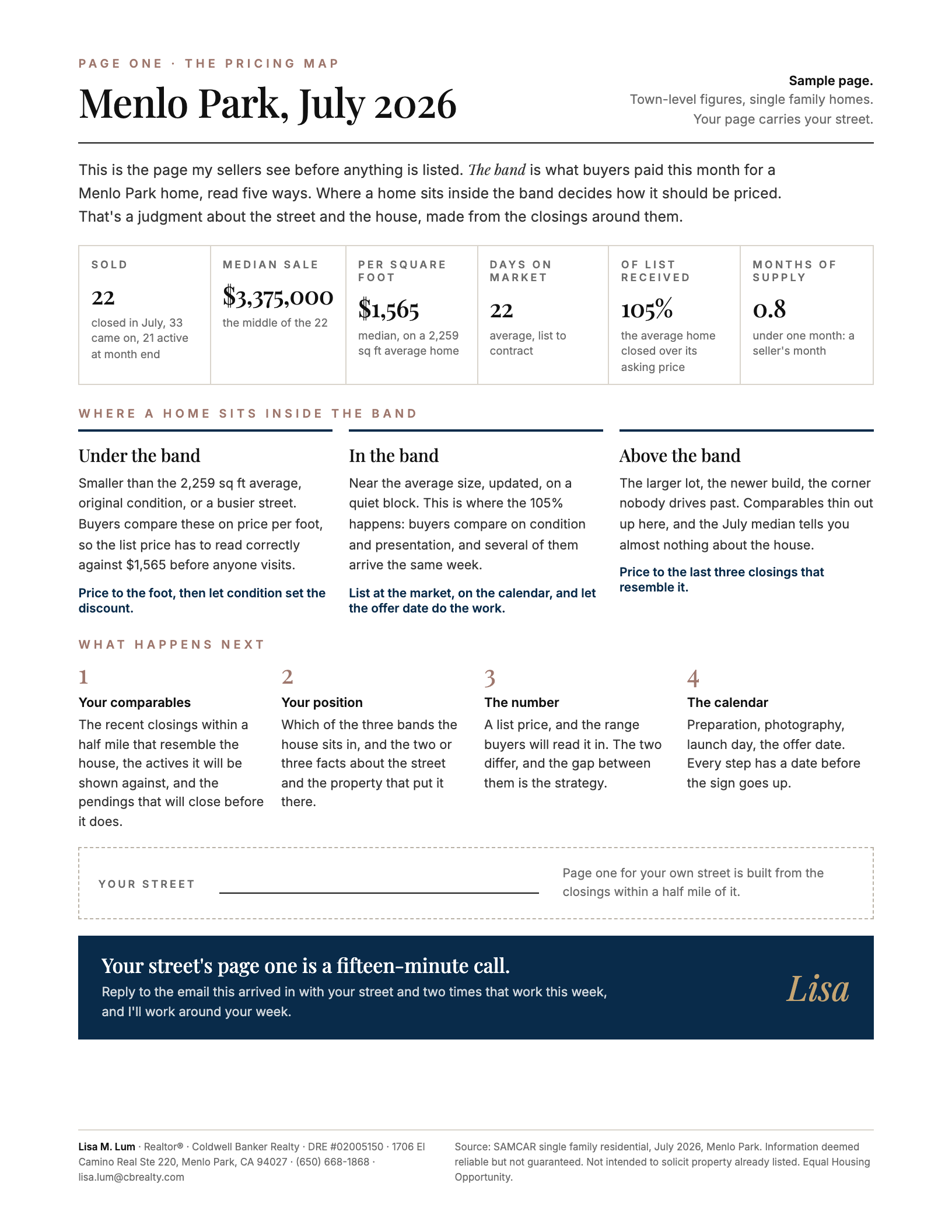
- Sellers: see your Page One before you list. Page One is the one-page pricing map I prepare for a seller before anything is listed. It shows where your home sits against the most recent closings, which comps a buyer's agent will use against you, and the price band that produces competition rather than a reduction. It's the first document to read in a 7% market. The Menlo Park sample below is the July 2026 edition.
What to Watch Between Now and Thanksgiving
Three things will decide whether this fall feels like a pause or a reset.
First, the county reports for August, due later this month from SAMCAR and SCCAOR. August closings reflect contracts written in July, before the jump, so any softening will be modest. The September report, due in October, is the one that will show the rate effect in the numbers.
Second, the Fed's next meeting on October 27 and 28. Sixteen of the 18 participants projected another hike this year, so the market has already priced that in. October carries no new projections, so the signal is the statement and press conference: a third increase, or a pause. A pause would likely pull the 10-year yield down and mortgage rates with it.
Third, inventory in the financed tier. If more sellers between $2 million and $4 million list into a thinner buyer pool, days on market in San Carlos, Redwood City, and San Mateo will lengthen first. If sellers hold back, as many did in 2023, the shortage will keep prices firm even with fewer buyers.
Stay informed: Get monthly market updates on Peninsula home prices, inventory, and rate moves delivered to your inbox, including the August county data when it lands. Subscribe to Lisa's Market Minute.
Frequently Asked Questions
Q: What are mortgage rates in the Bay Area right now, September 2026?
A: The Mortgage Bankers Association's average 30-year fixed rate for conforming loans reached 6.97% for the week ending September 11, 2026, with jumbo loans at 7.03%. Daily surveys from Mortgage News Daily put the 30-year fixed at 7.22% on September 15, and the Federal Reserve raised its benchmark rate a quarter point on September 16. Most Peninsula purchases above the conforming limit price off the jumbo rate.
Q: Did the Fed raise interest rates in September 2026?
A: Yes. On September 16, 2026, the Federal Open Market Committee voted 12 to 0 to raise the federal funds rate by 25 basis points to a range of 3.75% to 4.00%, the first increase in more than three years. Sixteen of the 18 participants projected at least one more hike this year.
Q: Are home prices in Menlo Park and Palo Alto dropping because of higher mortgage rates?
A: Not in the most recent county data. In July 2026, Menlo Park single-family homes closed at a median of $3,375,000 at 105% of list price with 0.8 months of inventory, and Palo Alto closed at a median of $4,280,000 at 108% of list in 17 days on market. Rates above 7% thin the financed buyer pool more than they change what a well-priced home on a strong street sells for.
Q: Should I sell my home on the Peninsula while mortgage rates are above 7%?
A: Sellers with a home in a top school zone or on a premier street still face very low competition: San Mateo County carried 1.0 months of inventory in July 2026 and Burlingame carried 0.4. The change at 7% is in who shows up: fewer stretched financed buyers and more buyers with cash or large equity. Pricing precision and buyer qualification matter more than they did in spring, and the right answer depends on your street, your timeline, and where your next home is.
Q: Is fall 2026 a good time to buy a home in Silicon Valley?
A: Fall 2026 offers a thinner field of competing buyers than spring and more room to negotiate terms such as seller-paid rate buydowns. Prices in the core Peninsula cities are holding, with inventory still under two months. A buyer who is fully underwritten, clear on total monthly cost at today's rate, and ready to move on the right house can win with fewer competing offers than in April or May.
The bottom line
The 30-year fixed crossed 7% this week, the Fed raised rates for the first time since 2023, and national buyer demand is 19% below last year. On the Peninsula, that means a thinner, better-capitalized buyer pool and a narrower margin for pricing error. The seller credit and the fully underwritten offer will decide outcomes this fall.
July's county data shows sellers still in control in every core city. The sellers who hold that position in October will be the ones who priced off the most recent evidence and saw their Page One before they listed.